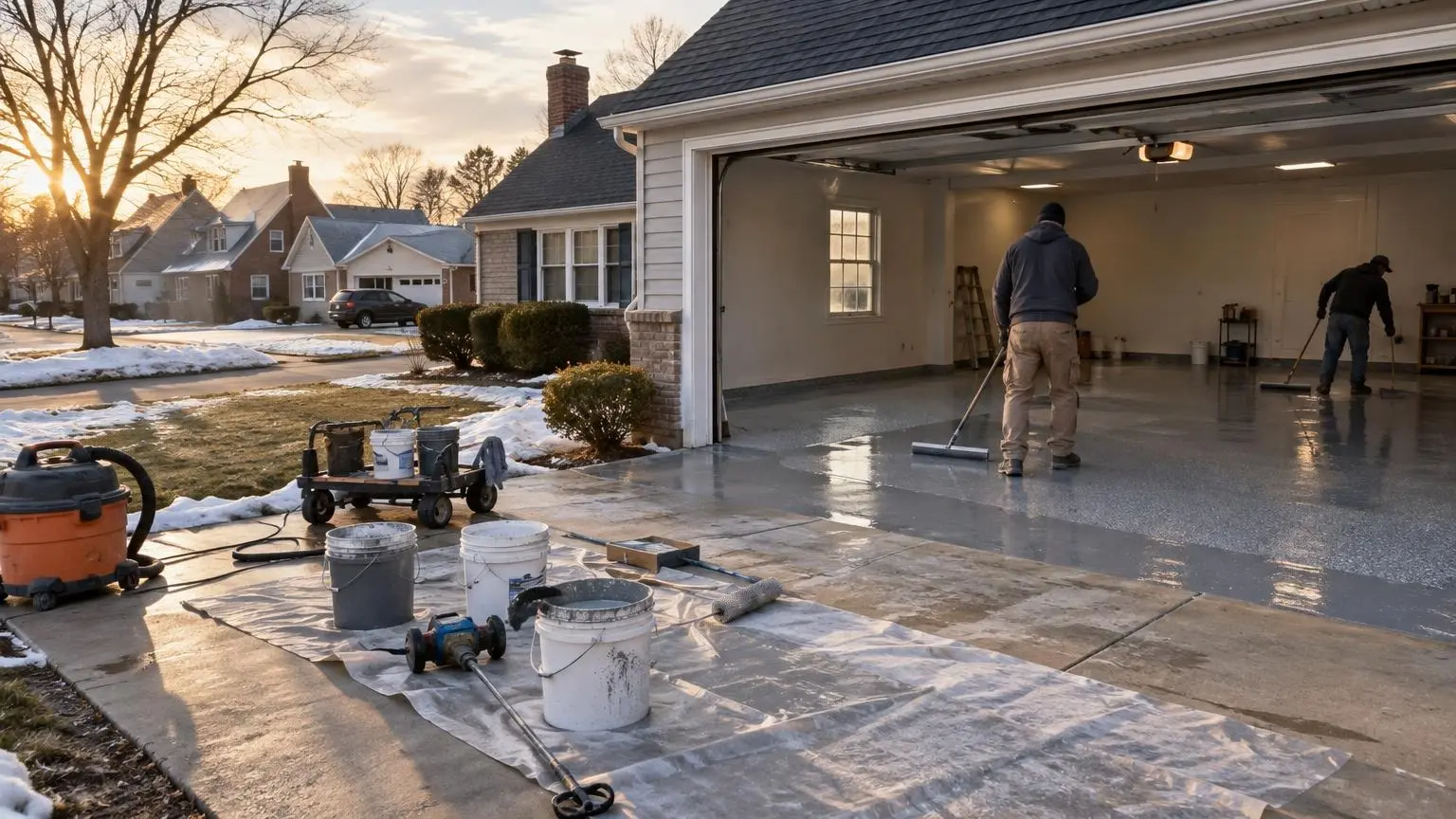
Garage, basement and shop floors in Erie County
Epoxy Flooring in Cheektowaga, NY
Coatings for the 1950s and 1960s slabs this town was built on, ground, repaired and sealed against a Buffalo winter.
- Free on-site estimate with a slab moisture check
- Itemized written quote before any work starts
- Every floor diamond ground and repaired before coating
Sealing Old Slabs Against Lake-Effect Winters
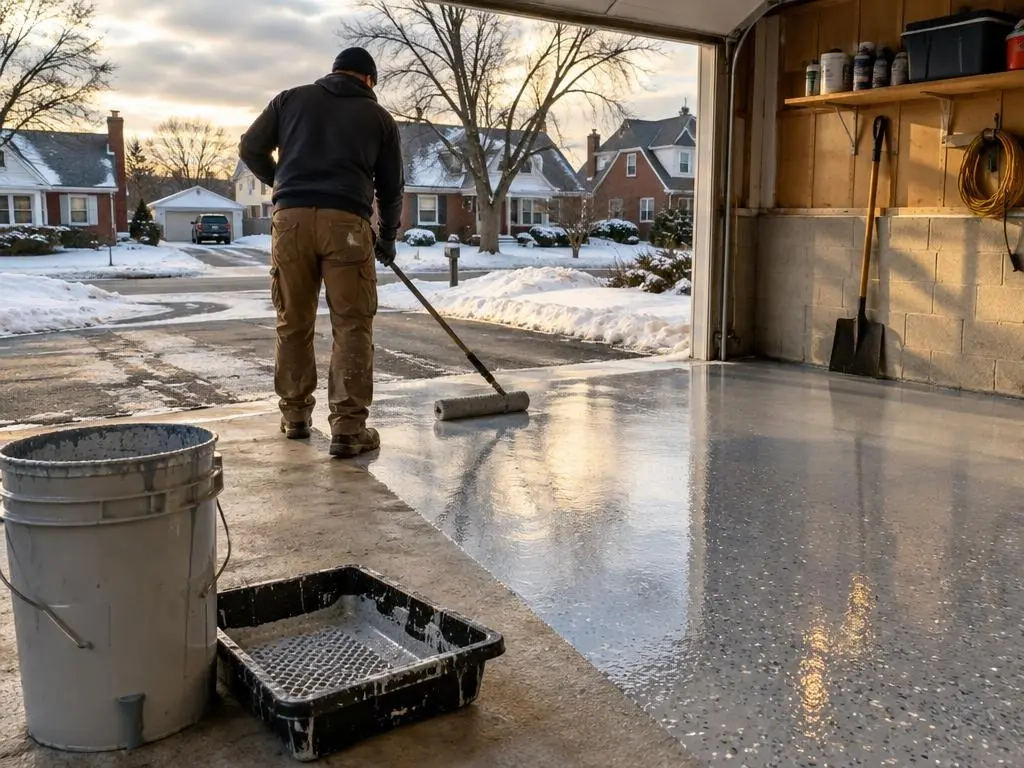
Epoxy flooring in Cheektowaga has to handle a serious winter. Buffalo Niagara International Airport sits inside the town, and the 1991 to 2020 normals recorded there average 95.4 inches of snow a year. Every one of those inches brings plows and salt, and the salt comes home on your car. By March, a typical garage floor here has spent months under puddles of brine. A coating that survives that needs a ground surface, a bonded base and a tough topcoat, and that is the kind of floor we install.
A town of 1950s concrete
Cheektowaga was mostly farmland until the subdivision boom after World War II. Census Bureau American Community Survey figures for 2019 to 2023, as published by Point2Homes, put the median year built for local housing at 1960. About 26% of homes went up in the 1950s alone, and only about 14% were built in 1980 or later. Roughly 65% of the housing units are detached single-family homes, and about 71% are owner-occupied. In practice, that means a lot of garages and basements with slabs that are six or seven decades old. Many have been painted, patched or sealed before, and some have settled or cracked. We plan around what is already on the floor.
What salt and cold do to a bare garage floor
The same normals put the average January temperature at about 25.5°F, so the slab near the garage door spends the winter swinging around freezing as cars come and go. Concrete is porous. Salty water soaks in, freezes and expands, and the top layer starts to flake. Wikipedia's article on road salt notes that salt speeds up the freeze-thaw effect on concrete and that rock salt is abrasive when used heavily. The first few feet inside the door usually show it first: pitting, scaling and white rings where puddles dried. A sealed coating keeps that brine on top, where a squeegee can push it out.
Basements and summer humidity
Buffalo's summers are humid. The normals list average relative humidity of about 68% in June and July and 72% in August. The EPA recommends keeping indoor humidity below 60%, ideally 30% to 50%, and notes that warm, humid air condenses on cold surfaces. A basement slab is one of the coldest surfaces in the house. Add moisture rising from the ground, and you get the blistering and peeling that ruin a lot of basement coatings. We test the slab before we recommend anything, and if moisture is high we use a primer rated for it or tell you the water problem has to be solved first.
A note on radon
The EPA calls radon the number one cause of lung cancer among non-smokers and lists 4 pCi/L as the level at which a home should be fixed. A floor coating covers cracks, but it is not a radon mitigation system. If you are finishing a basement, test for radon before the floor goes down.
Coating systems we install
- Epoxy base with a protective topcoat: a thick layer that bonds well to ground concrete, finished with a topcoat that resists abrasion and chemicals.
- Flake broadcast floors: vinyl chips spread into the wet base coat until it is fully covered, which hides dirt and salt residue and gives the floor grip.
- Polyaspartic coatings: fast-curing layers that shorten downtime and can go down in a wider temperature range than standard epoxy.
- Basement systems: moisture-tolerant primers and finishes picked after a slab test.
- Crack and surface repair: filling, patching and resurfacing so the coating sits on solid concrete.
- Shop and commercial floors: heavier 100% solids systems for carts, lifts, forklifts and spills.
What an installation includes
- An on-site visit to measure and check moisture, cracks, scaling and old coatings
- Removal of old paint or failed kit coatings
- Diamond grinding across the whole floor, edges included, with dust collection
- Crack, pit and joint repair, ground flush
- Base coat, flake or color layer, and clear topcoat
- Written cure times and a winter care routine for your floor
Why Homeowners Call Epoxy Flooring Cheektowaga
Grinding before coating
Every floor is diamond ground wall to wall. Old paint, sealers and salt-weakened surface concrete come off before any coating goes on.
Moisture tested at the estimate
Basements and older slabs are checked for moisture so the system we quote is one the floor can hold.
Finishes picked for winter
Garage floors get a chemical-resistant topcoat and texture, so salty slush stays on the surface and the floor has grip when wet.
One itemized price
Your written quote shows the square footage, each prep step, each coat and the total. Scope changes are written up for your approval first.
Common Questions
How much do contractors charge for epoxy flooring?
HomeGuide's national figure for installed epoxy is $4 to $10 per square foot, which works out to about $1,600 to $5,800 for a two-car garage. Polyaspartic runs about $5 to $12 per square foot in the same guide. Removing old paint, repairing salt damage and adding flakes all affect the price, so we quote in writing after seeing the floor.
What are the disadvantages of epoxy flooring?
Epoxy needs dry, well-prepared concrete, and it can blister or peel if moisture or oil is trapped under it. HomeGuide notes that standard epoxy can take up to a week to fully cure, and a smooth glossy finish can be slippery when wet. A ground surface, a moisture test, a UV-stable topcoat and added texture handle most of these issues.
Is a store-bought kit good enough for a Cheektowaga garage?
Kits at local home centers range from about $40 for a gallon of one-part epoxy paint to several hundred dollars for a two-part system. HomeGuide says water-based epoxy may need recoating every 3 to 5 years. Most kits rely on acid etching, which does not remove old paint or salt-damaged concrete. On a slab that takes salty slush all winter, the prep is what decides how long the floor lasts.
What materials go into a professional epoxy floor?
A typical system has a primer or base coat of epoxy, an optional layer of decorative flakes or color, and a clear topcoat, often polyaspartic or urethane. Crack filler and patching compounds go in before the base coat. The diamond grinder, dust vacuum and moisture meter matter as much as the coatings.
Can you coat a garage floor in a Buffalo winter?
Coatings need the slab and air above the minimum temperatures the manufacturer lists. HomeGuide notes polyaspartic can be applied in a much wider temperature range than standard epoxy, so it is often the choice for cold-season jobs. We measure slab temperature at the job, and if conditions are wrong we reschedule instead of forcing it.
Will a coating fix my flaking garage floor?
Flaking, or scaling, means the top layer of concrete has been broken down by salt and freeze-thaw. We grind off the loose material, fill the pits and low spots, and then coat. If the damage is deep across the whole floor, resurfacing may be needed first, and we will tell you that at the estimate.
Our Epoxy Flooring Services
Six services for the concrete you actually find in Cheektowaga: salt-scarred garage floors, aging basements, worn slabs that need repair and busy shop floors.
Garage Floor Coating
Ground, repaired and sealed garage slabs that keep road salt on top of the concrete instead of inside it.
Learn more →Epoxy Flake Floors
Full-broadcast chip floors with texture and color that hide salt film, tire marks and everyday garage dirt.
Learn more →Polyaspartic Floor Coating
Fast-curing coatings that keep the garage out of service for a short time and can go down in colder weather than standard epoxy.
Learn more →Basement Floor Epoxy
Moisture-tested basement coatings for the mid-century slabs under most Cheektowaga homes.
Learn more →Concrete Crack and Floor Repair
Crack filling, scaling repair and resurfacing to get worn mid-century slabs ready for a coating.
Learn more →Commercial and Shop Floor Epoxy
Heavier resin systems for shops, warehouses, garages and back rooms that take carts, lifts and spills.
Learn more →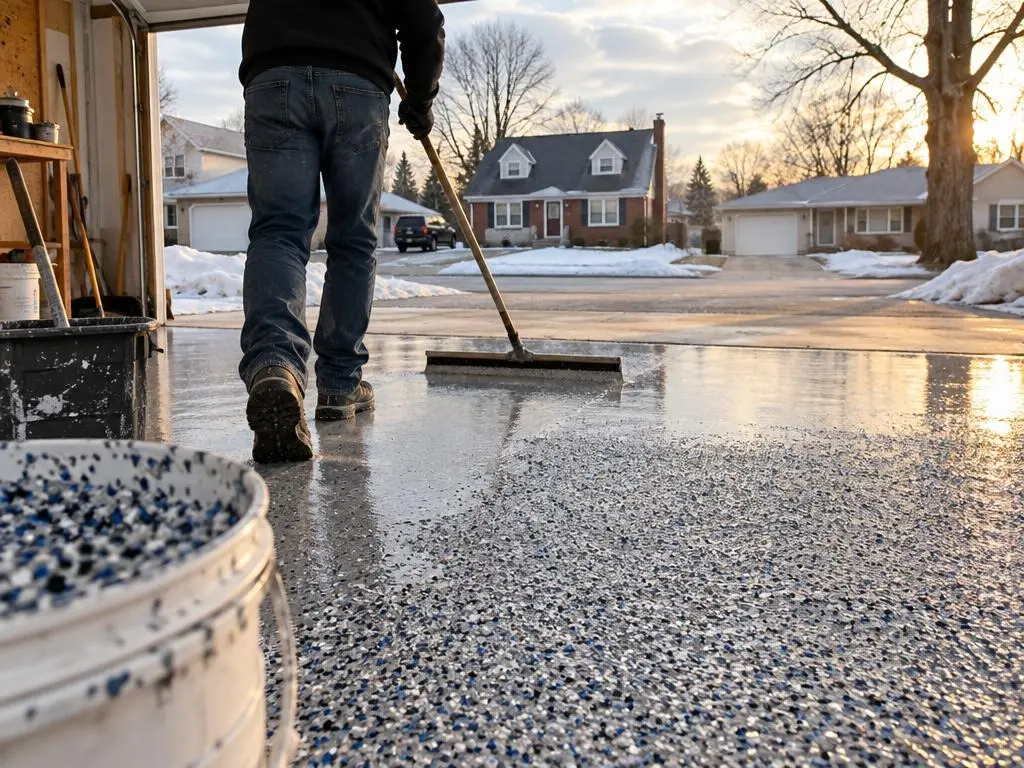
Where We Work
Cheektowaga is home base, including the villages of Sloan and Depew. From here we coat floors across the Buffalo suburbs: Lancaster, Amherst, Williamsville, Eggertsville, Snyder, West Seneca, the City of Buffalo, the Town of Tonawanda, Kenmore, Orchard Park, Hamburg, Clarence, Elma, East Aurora, Alden and Lackawanna, plus Grand Island, North Tonawanda and Lockport. The housing changes as you move outward. Inner-ring areas like Cheektowaga and the Town of Tonawanda filled in with suburban housing in the 1940s and 1950s, so their slabs are older and more often painted or patched. Clarence and the southern and eastern parts of Lancaster have grown much more recently, so their concrete tends to be younger. Every one of them gets lake-effect snow and road salt. Each area page explains what we see in that community.
- Epoxy Flooring in Cheektowaga, NY
- Epoxy Flooring in Depew, NY
- Epoxy Flooring in Sloan, NY
- Epoxy Flooring in Lancaster, NY
- Epoxy Flooring in Amherst, NY
- Epoxy Flooring in Williamsville, NY
- Epoxy Flooring in Eggertsville, NY
- Epoxy Flooring in Snyder, NY
- Epoxy Flooring in West Seneca, NY
- Epoxy Flooring in Buffalo, NY
- Epoxy Flooring in Tonawanda, NY
- Epoxy Flooring in Kenmore, NY
- Epoxy Flooring in Orchard Park, NY
- Epoxy Flooring in Hamburg, NY
- Epoxy Flooring in Clarence, NY
- Epoxy Flooring in Elma, NY
- Epoxy Flooring in East Aurora, NY
- Epoxy Flooring in Alden, NY
- Epoxy Flooring in Lackawanna, NY
- Epoxy Flooring in Grand Island, NY
- Epoxy Flooring in North Tonawanda, NY
- Epoxy Flooring in Lockport, NY
Get an Epoxy Flooring Estimate
Free on-site estimates in Cheektowaga and across Erie County.